
Tuesday, 17 May 2011
Manga plates
These are great, but I think they work best like this with Japanese food which is carefully prepared and arranged. I can't quite imagine it working with egg, chips and mushy peas ...
 via DesignBoom

Friday, 13 May 2011
Pendulum Waves
Beautiful and mesmerising. "Fifteen uncoupled simple pendulums of monotonically increasing lengths dance together to produce visual traveling waves, standing waves, beating, and (seemingly) random motion."
Wednesday, 11 May 2011
Paper fashion
Brazilian fashion designer Jum Nakao makes beautiful, delicate paper dresses which have been carefully folded and laser cut. At the end of each show they are then destroyed by the models as a way of challenging the audience's concepts of value and beauty.
via BoingBoing
via BoingBoing
Tuesday, 10 May 2011
The cult of done manifesto
How to get things done, especially if you're an expert procrastinator - read this by Bre Pettis and Kio Stark - NOW!


Monday, 9 May 2011
Vivienne Westwood: creation of A/W11 collection

Friday, 22 April 2011
'Before I die' street art
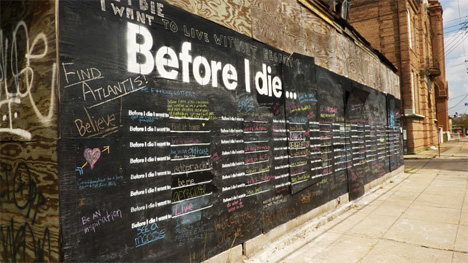
The response was overwhelming; often thought-provoking, sometimes touching, sometimes silly, but a real outlet for emotion.
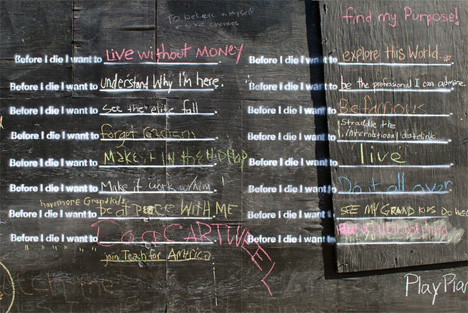
Full story here via WebUrbanist
Slow mo from high speed digital video
Digital video cameras are getting better and better which leads to imaginative people having more and more fun. This is a fine example - high speed video means you can do amazing slow motion, and this guy had amazing fun doing just that one night in his hotel bedroom:
Locked in a Vegas Hotel Room with a Phantom Flex from Tom Guilmette on Vimeo.
Locked in a Vegas Hotel Room with a Phantom Flex from Tom Guilmette on Vimeo.
Thursday, 21 April 2011
Knit your own Royal Wedding
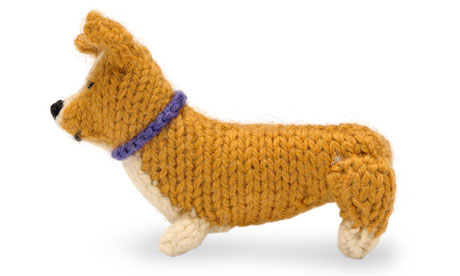
As a keen knitter I loved the idea (and the irony) of knitting your own Royal Wedding although I could anticipate how fiddly it would be and how much patience it would require. I did buy the book and my daughter knitted a bright pink corgi which it took me ages to sew together, then we ran out of energy!
via The Guardian
Book on Amazon
Sunday, 10 April 2011
Jaume Plensa at YSP
I am very lucky to live not too far from Yorkshire Sculpture Park, which always provides a very pleasurable day out. It combines three things I love good art, good food and a good walk! I am quite excited to see a new exhibition featuring the work of Jaume Plensa has just opened and I can't wait to visit. A taster of a few images from the YSP web site:


Full details here.


Sustainability: walk the walk
A beautiful little video... not only that but it is a great message. Truly inspirational and only just over a minute long too!
Wednesday, 30 March 2011
Dress made from children's books
This beautiful ball gown is made by designer / artist Ryan Novelline from lots of children's 'Golden Books'. The skirt is made from illustrations from the books sewn together with metallic thread and the bodice is made from the books spines.
 What is especially interesting is that he recorded his process with a fascinating series of photographs. Here's just a few...


There are lots more on his web site here.
Virtual shoe museum
The virtual shoe museum is an amazing resource of images of shoe designs ... and designs that really push the boundaries of what a shoe could be. They are all neatly categorised so you can bring up lots of images under different headings. Here are a couple of my favourites...
 |
| Julian Hakes: Mojito shoe |
 |
| Polly Verity: Wire shoes |
 |
| Paul Schietekat: High tide heels |
Sunday, 20 March 2011
A brief history of film title design
This is a beautifully-made short video showing the history of film title design. Not only that but there are some classic films there that I really must watch again!
Full list of the films mentioned on Vimeo here. Via BoingBoing.
Full list of the films mentioned on Vimeo here. Via BoingBoing.
Thursday, 17 March 2011
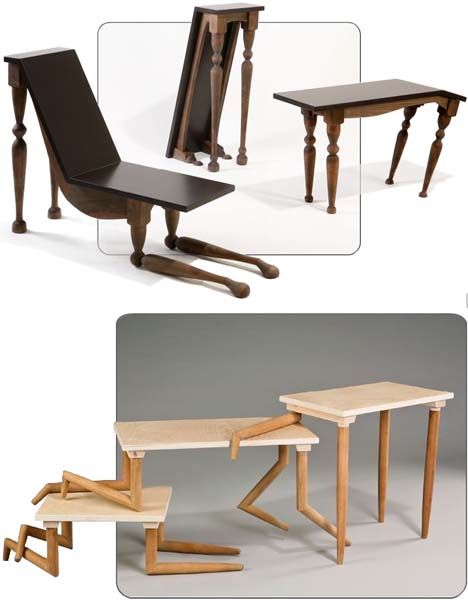
Wild tables
I love the concept and animation of these, though I don't think I like the final look of them somehow ...
 "It should come as little surprise that the designer of this sequence, Toot Chen, is not just a furniture maker, but also a stop-motion animator and graphic artist. His other works share a similarly sly and humorous approach to everyday household subject matter."
via DorNob
via DorNob
Warning signs
I think smart materials are going to be a fascinating growth area over the next few years and look forwards to seeing what innovative designers will do with them. Here is an interesting project:

"Warning Signs is a visualization of the pollution that exists invisibly all around us. When the wearable senses carbon monoxide, the piece subtly changes color and pattern to indicate higher levels of carbon monoxide in the atmosphere to the wearer and those around him or her. This piece was designed and created by Nien Lam and Sue Ngo."
Wednesday, 2 February 2011
We are all makers
This is a lovely TED talk by Dale Dougherty discussing the innate desire to make things he thinks is within us all. He shows lots of people doing stuff just because they can, they're enthusiasts and they like doing it.
What is interesting to me is what he sees as the importance of the social aspect of it all. That by going to events and meeting with other makers they show what they have made, share knowledge and go on to produce more and better things.
The enthusiasm they have and their ability to produce amazing things using low-tech solutions is something that would be great to see within more of my students!
What is interesting to me is what he sees as the importance of the social aspect of it all. That by going to events and meeting with other makers they show what they have made, share knowledge and go on to produce more and better things.
The enthusiasm they have and their ability to produce amazing things using low-tech solutions is something that would be great to see within more of my students!
Friday, 28 January 2011
10 second visit
On the face of it a 10 second tour of someone's home, portrayed as a series of still images doesn't sound that exciting, but it has surprising impact. Those fleeting glimpses of striking images are somehow compelling and stick in the mind, like being on a train at night and glancing into the rooms of passing houses.
I am a visiting tutor for the research training sessions at Sint Lucas School of Architecture (Brussels) and we ask our students to take a different look at the environment around them by photographing from a fixed point in a street outside the school, looking for artefacts that reveal knowledge about the people around them. I am wondering about incorporating something like this video into the project.
I am a visiting tutor for the research training sessions at Sint Lucas School of Architecture (Brussels) and we ask our students to take a different look at the environment around them by photographing from a fixed point in a street outside the school, looking for artefacts that reveal knowledge about the people around them. I am wondering about incorporating something like this video into the project.
Monday, 24 January 2011
Gangsta rap about cardboard boxes
This is great - a gangsta rap in praise of kids doing creative things with cardboard boxes and toilet roll tubes ... yes, really!
via BoingBoing
via BoingBoing
Sunday, 23 January 2011
How 'social' is social networking?
Facebook always provokes strong emotions; some people love it, spending their entire lives on there, and others hate it and will not go anywhere near it.
There is an interesting article in today's Guardian which suggests there is a growing body of evidence that social networking can have an isolating effect on people. People are getting more and more drawn into the 'social' media itself and so spending less and less time actually interacting with real people.
I love Facebook and spend quite a bit of time on there, not playing games, just reading the trivia about my friends lives and sharing my own, along with sharing interesting things I have seen or read. To me this feels like real, meaningful exchange, which increases my sense of connection with my friends. So, how come other people end up feeling that they are isolated observers of other people's lives?
I think the answer is to do with tacit knowledge. When I spend 'live' time with my friends I see their facial expressions, hear the nuances in their voices and can gauge their subtle reactions when we talk. After a while we build a tacit understanding of each other that then carries through to our online interactions. I can read between the lines of their posts or understand a whole lot more than was written into a brief text.
Looking back at my model of learning developed in my PhD, I would say that when I get to know somebody I have moved to the 'expert learner' stage where I can observe their online dialogue and understand without needing the 'bridges' provided by face-to-face interaction. So, for me this virtual contact is really meaningful, is often the starting point of conversation when I meet friends, and is a vital point of contact with friends who live far away and I see rarely.
For those who find it isolating, I guess they need more balance in their lives. They need to try to spend as much real time with people as they do virtual time, and to narrow that virtual contact to include many more real friends and to cut out many who are just virtual friends. My personal Facebook rule is that I am only 'friends' with people I know. Some of these are people I don't know well and am never likely to, but it would have been rude to refuse. So, I file them into a category where they do not see the personal things I post and I do not see theirs, they have had the satisfaction of adding me to their list but nothing more.
The same goes for so many things in life - a little in moderation is good for you - but too much of anything usually has negative side affects!
There is an interesting article in today's Guardian which suggests there is a growing body of evidence that social networking can have an isolating effect on people. People are getting more and more drawn into the 'social' media itself and so spending less and less time actually interacting with real people.
I love Facebook and spend quite a bit of time on there, not playing games, just reading the trivia about my friends lives and sharing my own, along with sharing interesting things I have seen or read. To me this feels like real, meaningful exchange, which increases my sense of connection with my friends. So, how come other people end up feeling that they are isolated observers of other people's lives?
I think the answer is to do with tacit knowledge. When I spend 'live' time with my friends I see their facial expressions, hear the nuances in their voices and can gauge their subtle reactions when we talk. After a while we build a tacit understanding of each other that then carries through to our online interactions. I can read between the lines of their posts or understand a whole lot more than was written into a brief text.
Looking back at my model of learning developed in my PhD, I would say that when I get to know somebody I have moved to the 'expert learner' stage where I can observe their online dialogue and understand without needing the 'bridges' provided by face-to-face interaction. So, for me this virtual contact is really meaningful, is often the starting point of conversation when I meet friends, and is a vital point of contact with friends who live far away and I see rarely.
For those who find it isolating, I guess they need more balance in their lives. They need to try to spend as much real time with people as they do virtual time, and to narrow that virtual contact to include many more real friends and to cut out many who are just virtual friends. My personal Facebook rule is that I am only 'friends' with people I know. Some of these are people I don't know well and am never likely to, but it would have been rude to refuse. So, I file them into a category where they do not see the personal things I post and I do not see theirs, they have had the satisfaction of adding me to their list but nothing more.
The same goes for so many things in life - a little in moderation is good for you - but too much of anything usually has negative side affects!
Saturday, 22 January 2011
Video concealing complexity
I have often observed that film of a skilled practitioner can easily conceal rather than reveal the complexity of what they do. I was just sent a lovely example of this in the form of this short video showing how to fold a shirt:
When I actually tried to copy what she was doing, with some help from a couple of friends, we could not figure it out at all until we found another video where we could follow the narrative in English (rather than Japanese). However, we still had to stop, restart and rewind the video several times until we got it.
In my experience of interpreting craft practice, video is great for giving a quick overview, inspiring someone to want to do it. However, the actual 'how to' is most efficiently put across with a few of simple line drawings to explain the crucial bits.
When I actually tried to copy what she was doing, with some help from a couple of friends, we could not figure it out at all until we found another video where we could follow the narrative in English (rather than Japanese). However, we still had to stop, restart and rewind the video several times until we got it.
In my experience of interpreting craft practice, video is great for giving a quick overview, inspiring someone to want to do it. However, the actual 'how to' is most efficiently put across with a few of simple line drawings to explain the crucial bits.
Subscribe to:
Posts (Atom)